Face Texture
- Snapchat: fully supported
- SPECS: not supported
- Camera Kit Web: fully supported
- Camera Kit Mobile: fully supported
- SnapchatFully supported
- SPECSNot supported
- Camera Kit WebFully supported
- Camera Kit MobileFully supported
The Face Texture resource allows you to get your Camera texture centered around a part of your face. It can be used, for example, for creating a picture in picture effect, or for applying a user’s face to a 3D object in your Lens. Its scripting API (FaceTextureProvider) is deprecated in favor of Face Crop Texture (FaceCropTextureProvider).
Create the Face Texture
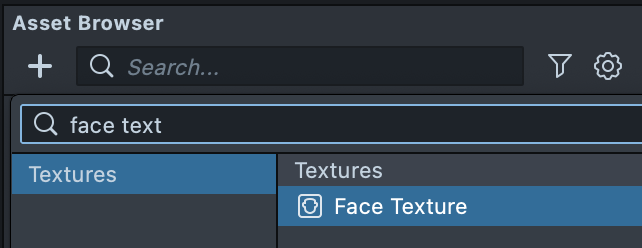
To create a Face Texture resource, first click the + button in the Asset Browser panel. Then, select Face Texture.
Assign Texture to a Screen Image
The Face Texture resource can be used anywhere a regular texture can be used.
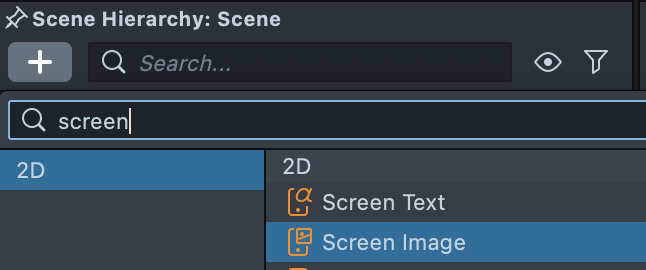
One way of displaying it is to use a Screen Image. In the Scene Hierarchy panel: + > Screen Image.
Then, in the Inspector panel, assign Texture to your newly added Face Texture resource.
Position The Face Texture
To modify where the image is displayed, double-click on the object in the Scene Hierarchy panel. This will open up the relevant editor, in this case, the 2D Editor panel.
In the 2D Editor panel, you can move your Screen Image around to position your Face Texture in the right place.
To learn more about Screen Image, checkout the Image guide
Face Texture Settings
With the Face Texture resource selected, you'll see the following settings used to configure the resource in the Inspector panel:
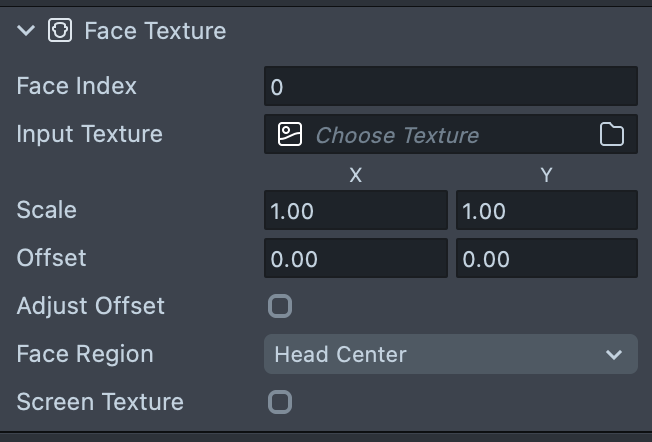
- Face Index: The index of the face this face texture is displaying.
- Input Texture: The texture which the face is extracted from. When left empty, the device camera texture is used.
- Scale: The UV Scale of the face texture. How the face will be fitted onto the texture.
- Offset: The UV Offset to shift the inset texture.
- Adjust Offset: When enabled, the
Offsetshift scales with the head's rotation (the sine of the angle, capped at 45°), so a head facing straight ahead gets no shift. When disabled,Offsetis applied as a constant shift. - Face Region: The area of the face this texture is centered to.
- Screen Texture: Whether the face texture should receive from the screen.