Transparent Permission
How Transparent Permission lets a published SPECS Lens combine internet connectivity with the camera, microphone, or location, and which combinations qualify.
- Snapchat: not supported
- SPECS: fully supported
- Camera Kit Web: not supported
- Camera Kit Mobile: not supported
- SnapchatNot supported
- SPECSFully supported
- Camera Kit WebNot supported
- Camera Kit MobileNot supported
Transparent Permission allows published Lenses to combine internet connectivity with sensitive user data (camera, microphone, or location) while maintaining user privacy through explicit disclosure.
When a Lens with Transparent Permission launches, two things happen:
- Permission prompt: A dialog appears listing which sensitive data the Lens will access
- LED indicator: If granted, the device's LED blinks while sensitive data is being captured
SPECS show the prompt and the LED themselves: your Lens doesn't implement them. If the user denies the prompt, the Lens doesn't launch.
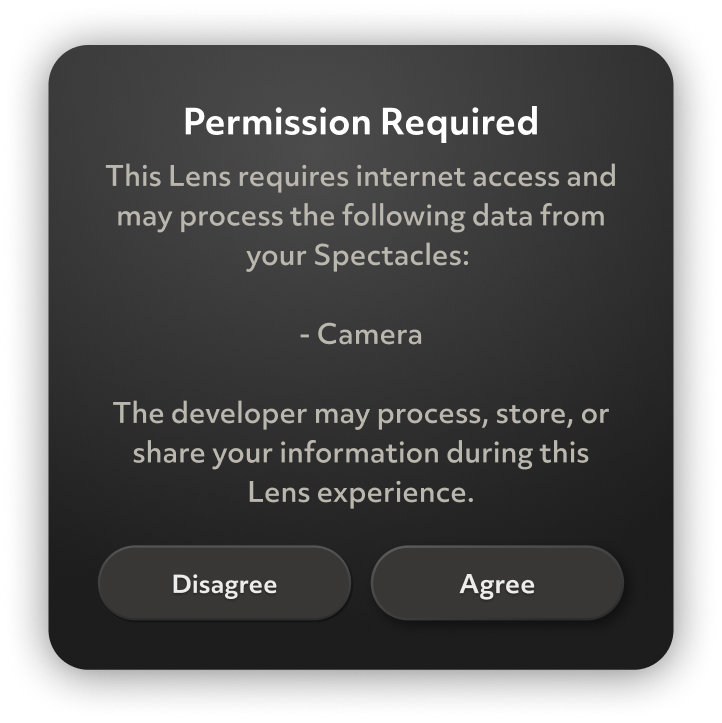
SPECS protect the user's privacy by default: a Lens can't combine external connectivity, such as the internet or Bluetooth, with sensitive data unless the user knows about it. Transparent Permission makes the combination possible by telling the user which data the Lens accesses, so the user stays in control of their data, particularly in internet-connected Lenses.
Lenses that use Experimental APIs still cannot be published to a wider audience.
Compatibility
Not all permission combinations work with Transparent Permission. These combinations do:
| Permission Combinations | Examples |
|---|---|
| Internet Descriptor + Connectivity type + Sensitive Sensor | Internet Module + SpectaclesSyncKit + ASR Module |
| Internet Descriptor + Sensitive Sensor | Remote Service Gateway + Camera Module |
| Web Socket + ASR Module | |
| Remote Service Module + RawLocationModule |
A Lens that uses one of these combinations can't be published, but the workaround makes it publishable:
| Permission Combinations | Examples | Workaround |
|---|---|---|
| Connectivity type + Sensitive Sensor | SpectaclesSyncKit + ASR Module | This combination cannot be published. However, adding Internet Module to the Lens will meet the requirement and the Lens will be publishable |
Module to Descriptor Mapping
| Internet Modules | Descriptors Applied |
|---|---|
| InternetModule | Internet |
| SupabaseModule | Managed Backend, Internet |
| SpectaclesMobileKitModule | SpectaclesKitModule, Internet |
| Connectivity type Modules | Descriptors Applied |
|---|---|
| ConnectedLensModule | Remote Connected Lenses, Colocated Connected Lenses |
| RemoteServiceModule | Remote API |
| BluetoothCentralModule | Bluetooth Peripheral |
| Sensitive Sensor Modules | Descriptors Applied |
|---|---|
| CameraModule | Camera |
| AsrModule | Microphone |
| AudioTrackAsset w/ MicrophoneAudioProvider | Microphone- SnapML |
| RawLocationModule | GPS - Precise |
| ProcessedLocationModule | Location - Coarse |
Extended Permissions
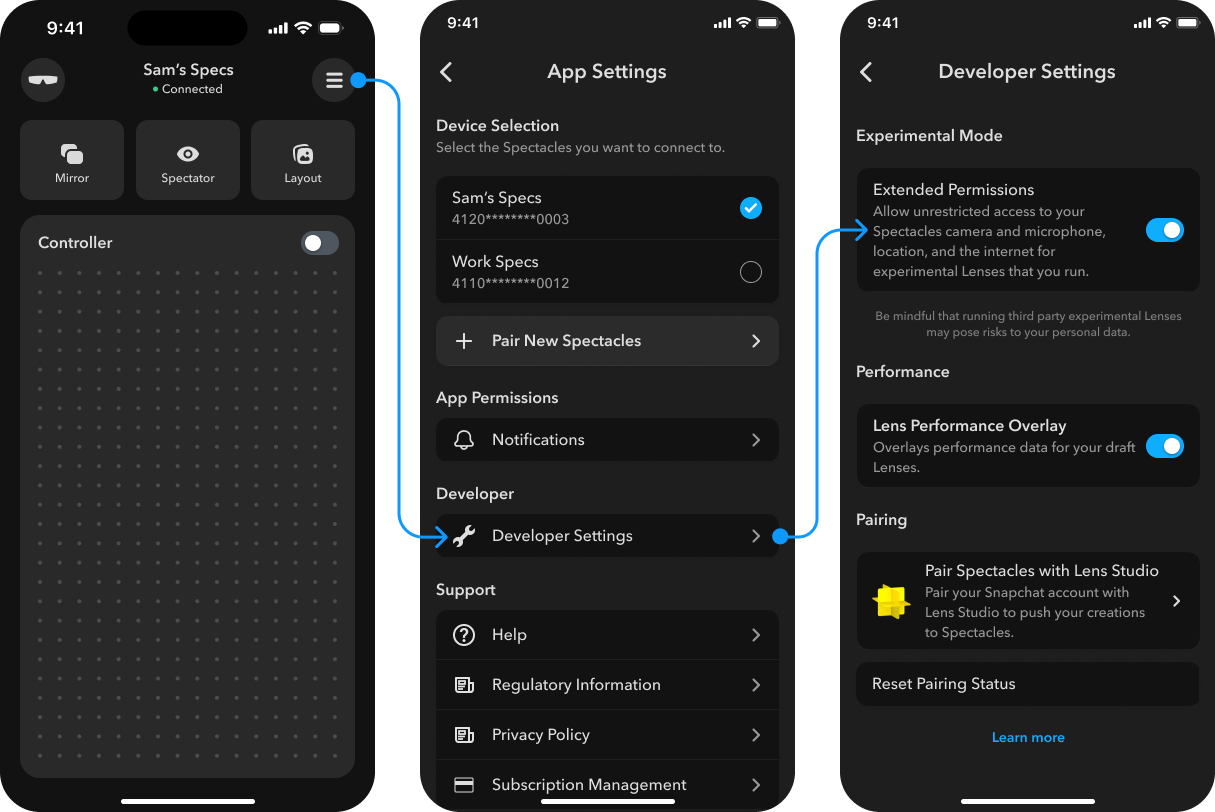
Extended Permissions is a user-controlled setting that bypasses Transparent Permission prompts by granting permissions by default. Users with Extended Permissions enabled will not see prompts when launching these Lenses.
Users can enable Extended Permissions in the SPECS App when they:
- Trust the developer or Lens source
- Want to avoid repeated prompts for frequently used Lenses
- Understand the privacy implications