Environment Setup Guidance
Set up physical environments for optimal VIO, SLAM, and scene understanding on SPECS with lighting, visual features, and layout guidance.
This guide provides environmental requirements and recommendations for optimal VIO, SLAM and Scene Understanding performance on SPECS.
Understanding Environmental Requirements
Visual tracking systems rely on environmental features and stable lighting to function effectively. The quality of your environment directly impacts tracking stability, power consumption, and user experience.
Key Systems
- VIO (Visual-Inertial Odometry): Tracks position and rotation (trajectory) over time by identifying features in the surrounding area
- SLAM (Simultaneous Localization and Mapping): Builds a map of the environment while simultaneously determining the device's position within that map, enabling spatial awareness and persistent anchoring
- Scene Understanding: Determines depth and surfaces in the environment
Why Environment Matters
- Feature Detection: The system identifies unique visual points (corners, edges, textures) to establish spatial reference
- Light Dependency: Insufficient lighting forces longer camera exposure times, increasing motion blur and power usage
- Pattern Recognition: Repetitive or uniform patterns confuse the system, leading to tracking drift
- Thermal Impact: Environmental temperature affects device thermals, which directly influence runtime and performance throttling
Reference Specifications
Lighting
Light the space evenly. In dim light, tracking quality drops and power use rises, especially during fast motion such as turning quickly or running.
Add overhead or diffused lighting to maintain consistent levels across the space.
Visual Features
| Parameter | Specification |
|---|---|
| Features per Viewpoint | Several unique and corner-rich features |
| Feature Distribution | Every viewing direction should contain distinct visual markers |
| Issues | Too few features, or repetitive uniform patterns, can result in mapping drift and tracking loss |
Add stickers, posters, decals, or textured props on walls and floors to enhance feature richness.
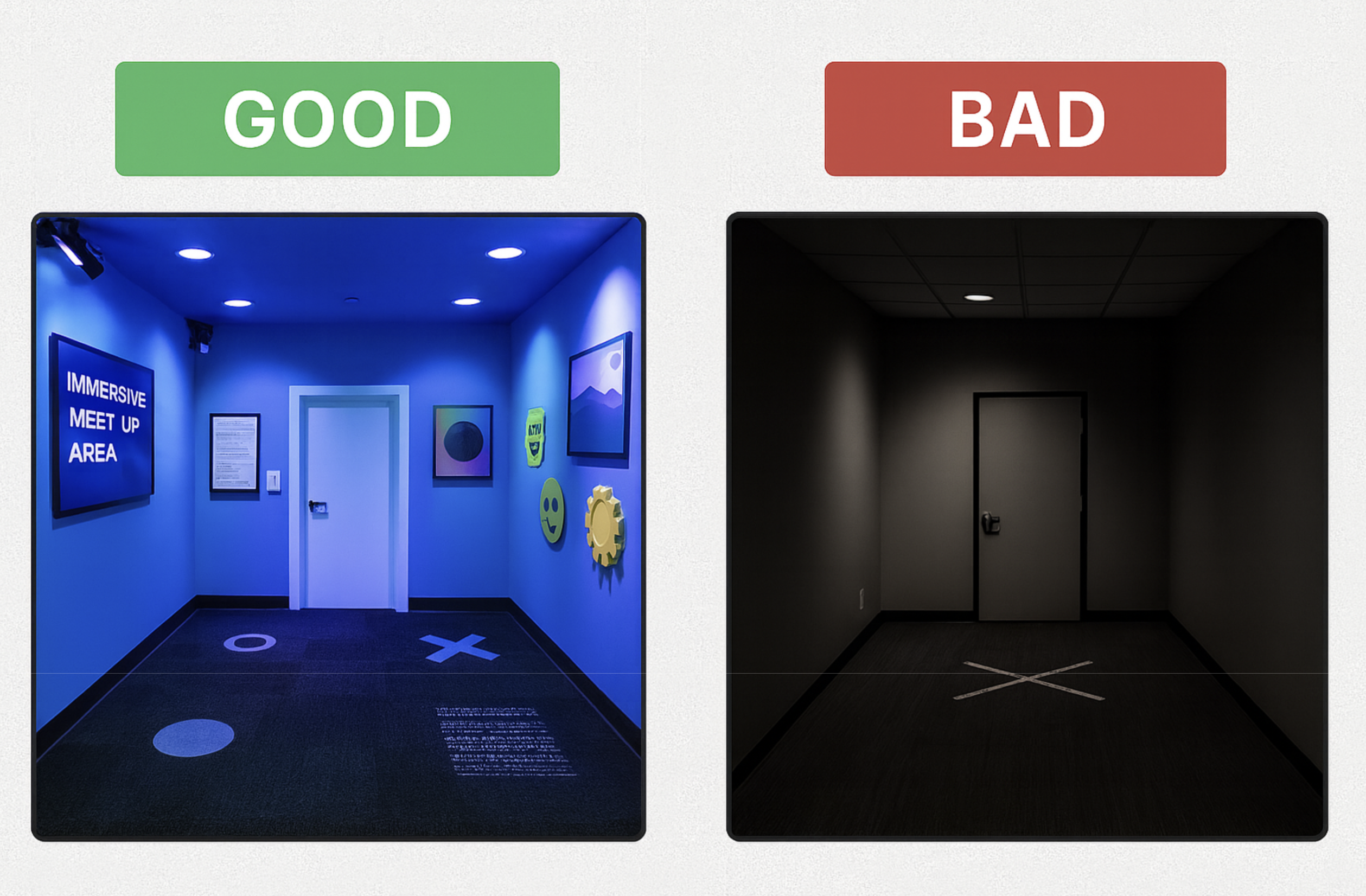
Environmental elements for SPECS tracking
Items that help tracking
| Surface | Recommended Items |
|---|---|
| Walls | Posters with bold designs, geometric decals, 3D textured panels |
| Floors | Contrasting rugs, floor stickers (shapes, arrows, checkerboards), geometric mats |
| Props | Small cubes, stools, plinths, textured display objects |
| Plants | Cacti, succulents (static geometry, corner-rich) |
Items that confuse tracking
| Item | Reason |
|---|---|
| Tape lines | Few corners, and repetitive, which can confuse the system |
| Leafy plants | Move with airflow, disrupting tracking |
| Duplicate graphics | Repetitive patterns cause system confusion |
| Large uniform surfaces | Provide insufficient feature differentiation |
Spatial Layout Guidelines
- Break up large open spaces with distinct markers or props
- Place features at varied heights and angles
- Ensure every direction has visually distinct characteristics
- Avoid environments where multiple viewpoints look identical
Temperature and Cooling
| Parameter | Impact |
|---|---|
| Ambient Temperature | Directly affects thermal performance and runtime |
| Higher Temperature Environment | Accelerates device heating and can cause earlier throttling, thermal standby mode, or shutdown |
| Lens Power Budget | Over-budget Lenses and high ambient temp will reduce device runtime |
Ensure good airflow, minimize direct sunlight exposure and maintain cooler ambient conditions to maximize device runtime and stability. To reduce your Lens's power use, see Optimizing Lens Performance.
Quick Reference Checklist
Use this checklist when setting up or troubleshooting your environment:
- The space is evenly lit
- Each viewpoint contains several unique and corner-rich features
- Removed or replaced tape lines with varied graphics or 3D props
- Added non-repetitive visual elements (posters, decals, props)
- Using static plants only (cacti and succulents, not leafy plants)
- Large spaces broken up with distinct markers at varied heights
- Good airflow and ambient temperature control in place